V V CEPHEI
V V CEPHEI DATA
V
V Cephei = HR8383 = HD208816
Name: ?
R.A. (2000) 21h 56m 39.1s
DEC. (2000) +63d 37' 33"
| COMP | A | B |
| SPECT. | M2
Iaep | B8
Ve |
| DIAM | 1621 | |
| MASS |
100 |
? |
| LUM. |
? | ? |
| ABS. | ? |
? |
| MAG |
? |
? |
| TEMP. | ? | ? |
| I
| 1.86 | V
- I | +3.04 | |
| R |
3.21 | R
- I | +1.40 | |
| V | 4.91 | B
- V | +1.77 | |
| B |
6.68 | U
- B | +0.39 | |
| U |
7.07 |
Distance: 3000 light years
Epoch: JD 2,435,931.4
Period: 7430.5 days/ 20.34 years
Secondary Eclipse at Phase: ?
Ingress/Egress: 100/200? days
Totality: 490 days
Next Eclipse: (2017)
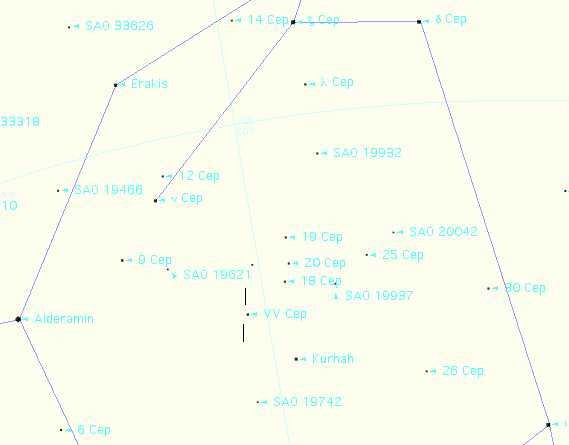
Secondary Eclipse - Fall/Winter 2005
Maximum Separation Date - ?
Recommended
Comparison Star:
20 Cep HR8426
R.A. (2000) 22h
05m 00.4s
DEC. (2000) +62d 47m 09s
I = ?; R = ?;
V = 5.27 **** 5.36
B = 6.68 **** 5.77
U = 8.46 **** 7.42
Check
Star:
19 Cep HR8428
R.A. (2000) 22h
05m 08.8s
DEC. (2000) +62d 16m 48s
R - I = 0.03
V = 5.11
B = 5.17
U =4.33
V V Cephei (Cep)
The V V Cephei star system has the second known longest period with a period of 20 years or 7430.5 days. V V Cep is a 5th magnitude system. The total eclipse is less than Epsilon Aurigae by nearly half a year (totality for Epsilon Aurigae is 670 days and for V V Cephei it is 490 days). The next eclipse of V V Cephei is due in 1997. V V Cep is one of the most massive binaries known. Its estimated mass is 100 solar masses and the primary star has a diameter of 1621 times the Sun. If it were our star, its surface would extend to between the orbits of Saturn and Uranus.
Reference: Van De Kamp, P. 1978, Sky and Telescope; The Distances of V V Cephei and Epsilon Aurigae, 397-399, November 1978.
Note:
Phil
Bennett (CASA, U. of Colorado) has requested observations of VV Cep begnning
summer of 2005 through spring of 2006 in order to try and catch the secondary
eclispe. Any questions /data should be sent to Phil at [email removed]
HPO UBV Data of VV Cephei
and
Check Star 19 Cephei
Comparison Star Used: 20 Cephei
Modified 16 June 2006
